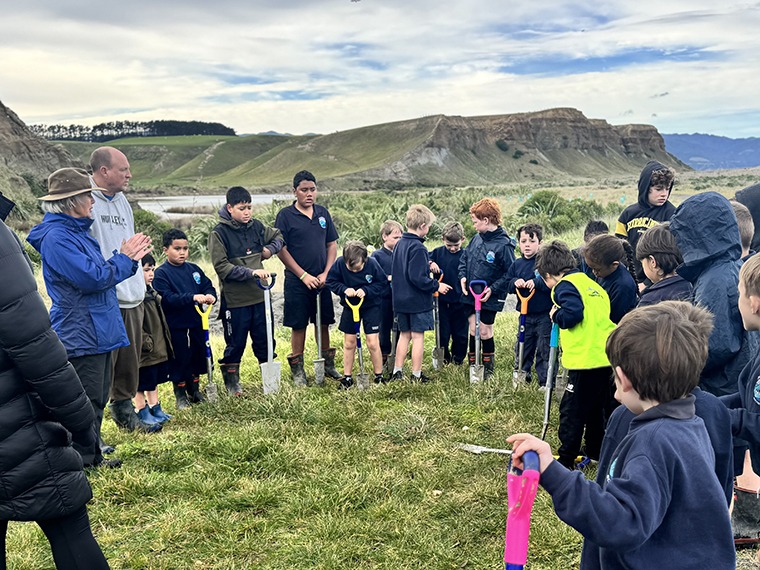
It was a fun day out at Ōkorewa Lagoon on the south coast in mid August, as the mahi of nine local organisations came together for a common cause. The event was a collaboration between the South Wairarapa Biodiversity Group (SWBG), the Aorangi Restoration Trust (ART), and Ruamahanga Farm Foundation’s (RFF) education project, Te Reo o te Wai. The highlight ingredient that brought it all to life was the involvement of nearby Pirinoa School.
For 12 years, SWBG volunteers have been steadily planting the edges of Ōkorewa Lagoon, creating important habitats for birds that fly and those that don’t – like kororā, the little blue penguin. Standing just 30cm tall, kororā are the world’s smallest penguin. Once a familiar sight under coastal baches and rocks, and still often spotted by fishermen at sea, their onshore story is one of quiet decline. Loss of habitat and introduced predators – stoats, ferrets, weasels, rats, wild pigs, and roaming domestic or feral dogs and cats – have sharply reduced their numbers.
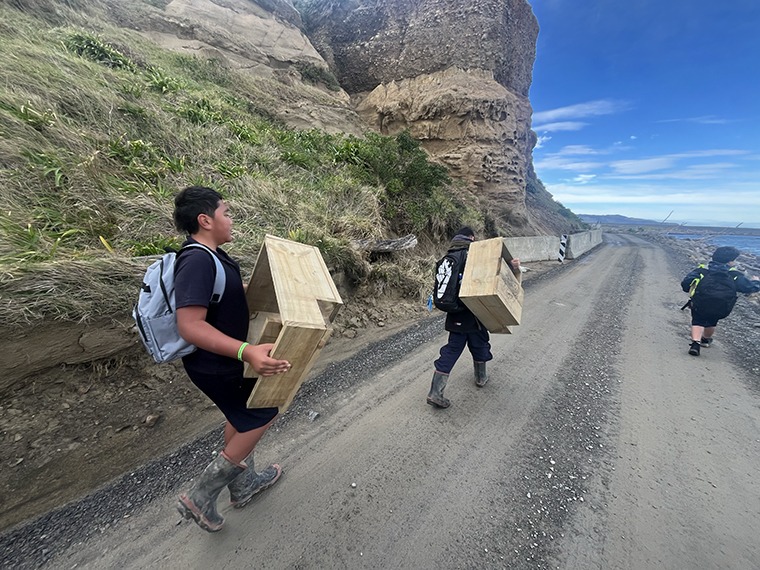
Over the same period, the Aorangi Restoration Trust has placed penguin boxes along the coast and set hundreds of traps for possums and mustelids. Sponsored by the Martinborough Lions and P&K Mitre 10 and built by the Martinborough Mens Shed, the boxes offer safe nesting sites along the rugged coastline. Their narrow, protected entryways help keep predators out and give breeding pairs a better chance of raising chicks.
Ōkorewa Lagoon, just around the point east of Lake Ōnoke, is an easy ten minute walk from the Lake Ferry Hotel carpark.
A bus sponsored by Green Jersey Cycle Tours brought children from Pirinoa School to take part. Equipped with bushpro spades donated to RFF by the South Wairarapa Rotary, each child planted and weed matted up to ten native plants – a mix of flood tolerant sedges such as carex secta / pūrei and salt tolerant trees including kanuka.
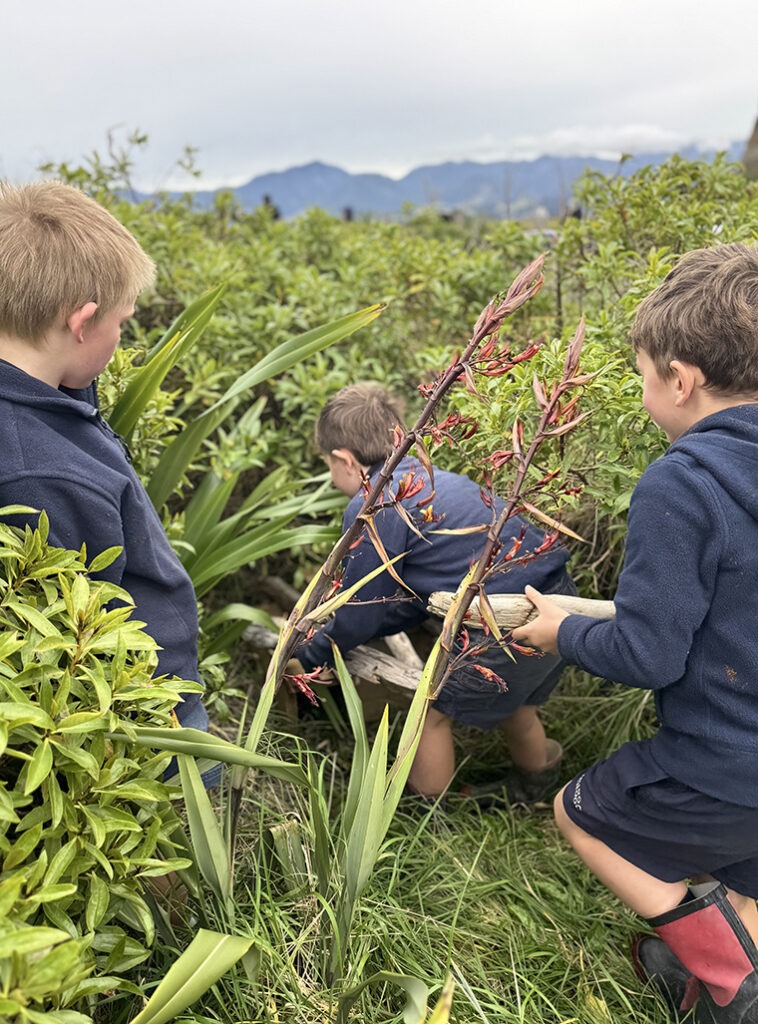
Each class then found a sheltered spot, created by previous years’ plantings, to hide their penguin box. Hunting for logs to secure and camouflage the boxes proved especially popular. By the end, each box looked less like a simple structure and more like a den-style penguin palace.
As with all RFF’s Te Reo o te Wai field trips, time was set aside at the end of the day – and again back at school – for reflection and sharing. The students wrote letters to the penguins, expressing their hopes for protecting kororā and their pride in helping restore the lagoon.
Here’s a glimpse of how the children felt about protecting penguins
Dear Penguins, We made you some penguin houses to protect you so you can’t die easily. I hope it’s a happy place for you to live and your babies can be safe.
KAHUKURA
We put driftwood on top of it so dogs can’t lift them up. I hope you have a nice time in the penguin house.
QUINN
All hidden in the bushes and covered in driftwood – they look like soldiers wearing camouflage. We planted nice new trees before we did the little kororā boxes.
HUNTA
The trees are native which is good. The boxes are hidden quite far away from the ocean. It will be a long journey, I hope you stay safe.
HUGO
They are near the Lake Ferry pub right next to the rocky cliffs that are as jaggy as knives.
REID
It might take you quite a while to get there, but it is worth it for your cool new houses.
BRAX
The weather was blazing cold like a massive ice cube, so it was super-duper hard to carry the boxes and the logs in the freezing cold. Me and the whole school hope you move in to keep yourselves safe like sea shells in the ocean… good luck !
KYAN
How you can help
It will take many hands and many eyes to bring kororā back to our coast again. If anyone has a sighting of kororā, please email the details (date, time, and location) to the Aorangi Restoration Trust at aorangitrust@gmail.com.