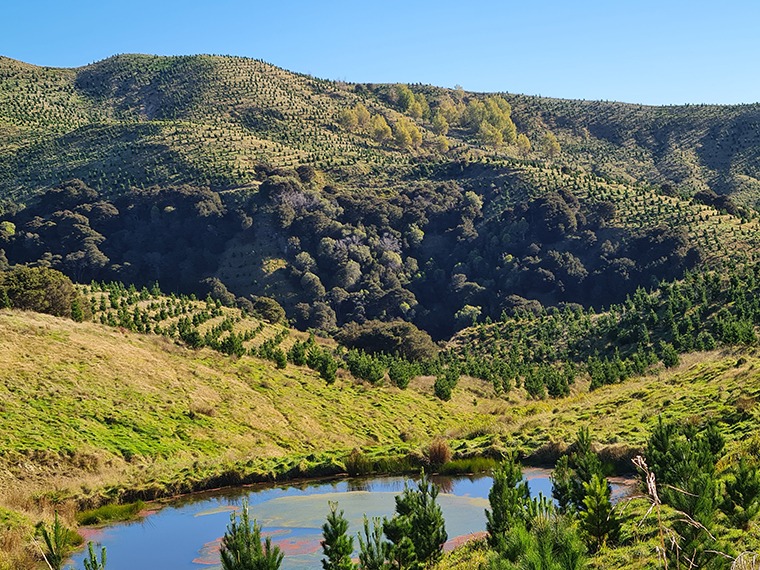
Commercial forestry is essential to New Zealand. We need timber for housing, packaging, infrastructure, furniture, and increasingly as a lower-emissions substitute for concrete, steel, and plastics. The real question is not whether we should have forestry, but what kind of forestry system we want.
At present, much of New Zealand’s forestry sector relies heavily on a single model: large-scale Pinus radiata plantations managed on short rotations and harvested through extensive clear-felling. This system is highly productive and commercially successful, but on steep or erosion-prone land it can cause substantial downstream environmental and infrastructure impacts, particularly in the years immediately following harvest.
Forestry diversity matters for the same reasons diversity matters in agriculture and investment portfolios. Relying too heavily on a single species and management model, concentrates economic, biosecurity, and environmental risk. A broader mix of species, including natives, cypresses, redwoods, eucalypts, and durable hardwoods, could improve economic and environmental resilience, support a wider range of higher-value wood products and processing industries, and better match different trees to different soils, climates, and end uses. However, greater diversity also brings trade-offs. Some introduced species can become invasive weeds, so diversification must be accompanied by careful species selection and long-term management.
Silviculture and harvesting methods also matter. Paired with high-value timber species, continuous-cover forestry, staggered harvesting, smaller clear-fell areas, and lower-impact cable harvesting systems can reduce soil disturbance, erosion, sediment flows, and slash mobilisation while supporting commercially viable forestry.
Research following major storm events in New Zealand has consistently found higher rates of shallow landslides on recently harvested forest land than under established forest cover.
The environmental evidence is increasingly difficult to ignore. Research following major storm events in New Zealand has consistently found higher rates of shallow landslides on recently harvested forest land than under established forest cover. A major Hawke’s Bay assessment following the March 2022 storms found the highest landslide densities occurred on pasture and recently harvested exotic forest, while established indigenous and exotic forests experienced substantially fewer landslides. Research in Tasman reached similar conclusions, finding that maintaining permanent forest cover and limiting large-scale clear-fell harvesting on erosion-prone slopes could significantly reduce landslide risk.
Too often, downstream communities carry the costs through damaged property, roads, bridges, waterways, and repeated flood recovery.
Forestry is, and will remain, an important component of our primary sector. But building a more resilient forestry future requires greater species diversity, lower-risk harvesting systems, and a fairer balance between private benefit and public costs.