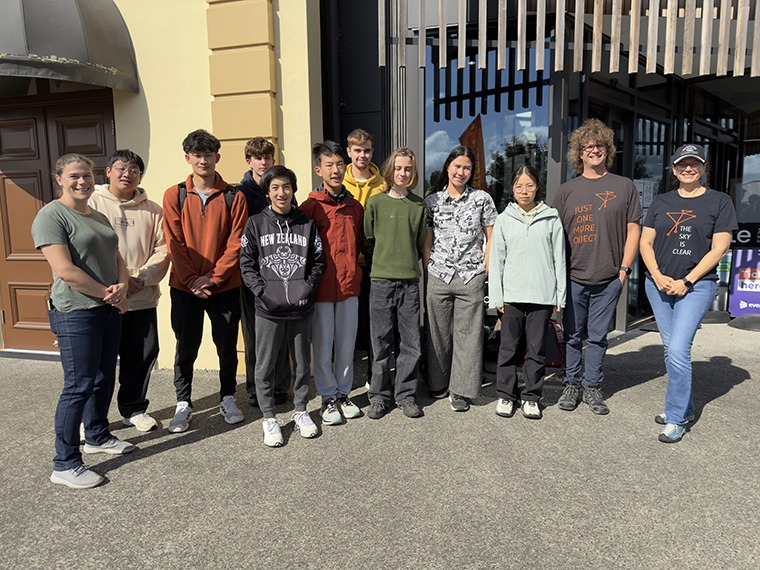
Martinborough’s dark skies recently hosted a group of New Zealand’s most promising young astronomers as part of the national selection process for the New Zealand Astronomy and Astrophysics Olympiad team.
Martinborough’s dark skies recently hosted a group of New Zealand’s most promising young astronomers as part of the national selection process for the New Zealand Astronomy and Astrophysics Olympiad team.
The training camp, held from 8 to 10 April, brought together students from across the country to prepare for the international competition taking place in Vietnam later this year. The camp was run by members of the New Zealand Olympiad training team, with sessions held at the Waihinga Centre and at Star Safari Observatory, a ten-minute drive north
of Martinborough.
The decision to hold the camp in Wairarapa was driven in large part by the region’s outstanding night sky conditions and the availability of specialised facilities. The observational training programme, led and organised locally by Hari Mogoşanu and Sam Leske, was centred at Star Safari Observatory. Working alongside the national training team, they encouraged the move to Martinborough, highlighting both the internationally recognised dark skies and the ability to provide students with hands-on access to a wide range of telescopes. This proved instrumental in delivering the practical component of the training.
The Wairarapa Dark Sky Reserve provided an ideal setting for the camp, with clear skies allowing students to gain hands-on experience in observational astronomy. Evening sessions at Star Safari Observatory gave students the opportunity to work with a range of telescopes and test their practical skills in identifying stars, constellations, and deep-sky objects.
Daytime sessions took place in a portable planetarium, known as the “Mars Blueberry”, where students practised essential skills such as reading the night sky, understanding celestial coordinates, and estimating time from the positions of stars. These are key components of the international Olympiad, where students are tested equally on theory and on their ability to interpret the sky itself. Camps such as this one are an important step in preparing students to compete on the world stage.
The presence of such a programme in Martinborough highlights the growing recognition of the region, while a destination for visitors, Wairarapa, is also a place for education and scientific engagement.
The presence of such a programme in Martinborough highlights the growing recognition of the region, while a destination for visitors, Wairarapa, is also a place for education and scientific engagement. With its internationally recognised dark skies and local initiatives supporting astronomy and astro-tourism, the Wairarapa continues to offer unique opportunities to connect with the night sky.
As part of their training, students are often asked to solve problems based on real observations. Here is a simplified version readers might like to try:
If a star currently overhead has a right ascension of 16 hours, and the Sun’s right ascension is about 6 hours, what time is it?
(Answer: about 10 pm. Astronomers can tell the time just by looking at the stars.)