It has stood, and slowly crumbled, through more than 155 years of Featherston weather.
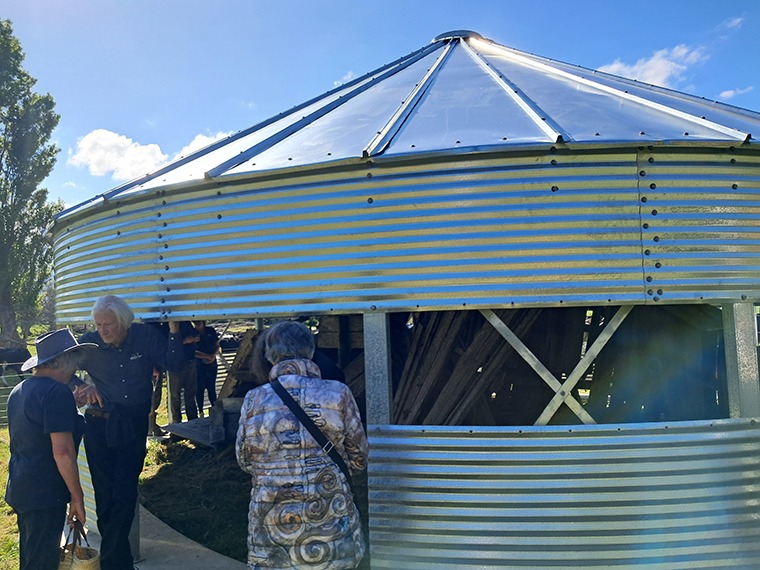
Now, the totara plank-and-beam remains of the historic Carkeek Observatory, a Category 1 heritage structure, have a new layer of protection in the form of an open steel silo.
Thanks to the efforts of former mayors, councillors and council staff, funding and resources were secured to preserve a unique piece of New Zealand’s astronomical history. The observatory remains an important part of the Wairarapa Dark Sky Reserve story.
Built by Stephen Carkeek on his farm, the observatory is believed to be the first and longest-surviving private astronomical observatory constructed in colonial New Zealand. Carkeek, a retired civil servant turned sheep farmer, built the structure from hand- and saw-hewn totara. It is one of only a handful of surviving Romsey-style observatories worldwide.
Mayor Fran Wilde, former mayor Martin Connelly, current and former councillors, Carkeek descendants, the silo’s architect, council staff, Rangitāne representatives and members of the Wairarapa Dark Sky Reserve were among nearly 40 people who attended the recent unveiling, which featured no formal speeches.
The observatory, classified as a ruin by Heritage New Zealand, stands on land farmed by the Hodder family for four generations. South Wairarapa District Council has since purchased the property as part of its Featherston wastewater disposal project.
The 30-metre-diameter silo is already providing critical protection for the site, safeguarding a local taonga while adding to the region’s human dark sky story, which began with Kupe’s arrival in Kawakawa Bay.
Inside the structure, the observatory’s remaining totara frame and planks still lean partly on the stump and trunks of a walnut tree that grew through the middle of the building. Its branches helped prevent much of the observatory from collapsing into the surrounding paddock. The tree has since been cut back to fit within the silo while continuing to support the remaining structure.
Among those attending were descendants Steven Carkeek, Ra Higgot, Christine Carkeek and Tanya Cowen.
“I think it’s brilliant. It looks good too,” Cowen told The Star.
“The contrast between the wooden remains and the silo structure is remarkable. It’s a really neat thing to look at.”
Steven Carkeek also visited the last remains of the hand-built totara fencing that once surrounded the family’s 200-acre farm.
“They had no money for wire or nails,” he said. “So, they carved holes in posts and slid rails into them.”
Guests appeared delighted with the project, although several raised questions about how the remaining planks, walls and framing could be protected from further deterioration.
A visit to the observatory is planned as part of the proposed inaugural Featherston Heritage Festival on 8-10 November, coinciding with the Wellington Heritage Festival.