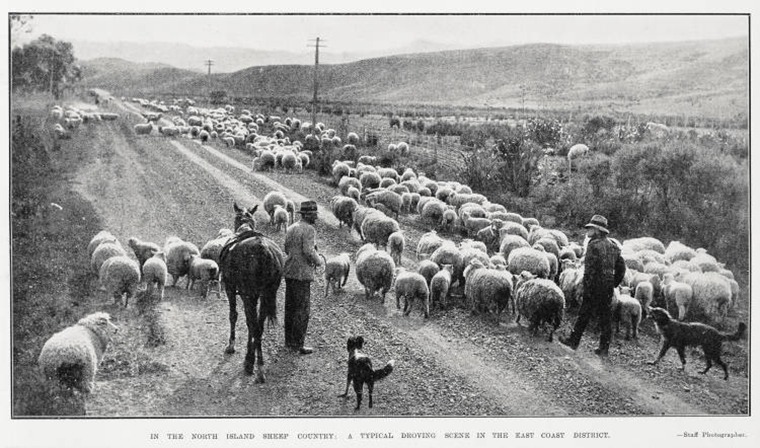
Droving – the slow, careful movement of livestock along roads or across country – was once a defining part of Wairarapa’s farming life.
A good drover knew how to strike the “sweet spot” – move stock too fast and they’d lose condition; too slow and time was wasted. The long acre of roadside grass offered a free feed, useful when farmers were short of pasture or needed animals to put on condition before heading to the works.
From the beginnings of pastoral farming in 1844 through to the mid-1960s, droving shaped the region. Roads Boards and Councils purchased holding paddocks at strategic points so drovers could get stock off the road overnight. Many of these small plots remain in Council ownership today. Metal “borrow pits” sometimes doubled as holding paddocks, otherwise drovers relied on friendly farmers along the route.
From the beginnings of pastoral farming in 1844 through to the mid-1960s, droving shaped the region.
Early records at Lake Ferry show pioneers driving stock around the coast. If Lake Onoke’s outlet was open, the hotel license holder had to provide a boat to ferry drovers and stock across – the origin of the name “Lake Ferry”. The old ferry charges board still hangs in the South Wairarapa District Council offices.
Droving could be dangerous. In February 1923, 120 bullocks being driven around the Whatarangi bluffs accidentally swam out to sea; four drowned, though the rest made it ashore. The stretch between Pahaoa and Te Awaiti became known as the “Devils Mile” for its risk of losing stock to the waves. In January 1920, a span of the Kahutara bridge collapsed during flooding, drowning 22-year-old drover Len Johnston, recently home from the War. He had been driving cattle from White Rock Station to the Featherston railhead.
A drover’s “plant” was simple: a pack horse, saddle and gear, drovers’ whips, a cash box, one or two good dogs, a tarpaulin or swag, billies and utensils, and the skill to keep stock moving. It was a hard life.
The shift from droving to trucking began in the 1920s and accelerated through the 1960s. A 1923 Wairarapa Age article titled Motor Lorry v. Drover compared lambs driven to the works with those trucked. The conclusion favoured the lorry – though drovers of the day would surely have disagreed.
Many names remain fondly remembered: William J. Gray of Whatarangi; Arthur and William Allsworth; Len Johnson; Harry Charles Barton; Stanley Roberts; Tex and Wattie Charteris; Neil McLaren; Geoff Diederich; Ewen Bruce; Buster Rolls; Roy Amos; Jack Rawhiti (Rafferty); Derek Orchard; Freddie Bird; Bub Salsbury; Les Briant; Terry and Eve Youngman; Richard McGillicuddy; Link Campbell; Bob Madden; Bob Buick; Dave Harris; Bob Sargent; Webb Harris; and Ian Moffitt.
Stories endure too. Peter Youngman recalls his father Terry droving stock from White Rock to Martinborough and across the Wairarapa. Lesley HainesHamilton remembers Jack Rawhiti’s striking white horse, Blaze, and following him to the New York Street saleyards. Graham Moran remembers Jack as “a hell of a nice person, always up for a friendly chat”.
Dave Palmer recalls Geoff Diederich’s booming laugh, rodeo belt buckles and zebra-striped Dodge Power Wagon. Geoff broke in horses and ran a knacker’s yard supplying stock food.
Ewen Bruce says Jack Rawhiti drove the last herd of sheep to the Featherston railway yards around 1965, though Kim Charteris remembers droving stud ewes in the early 1970s. Hugh Hunter recalls a newcomer objecting to horses crossing a neatly mown berm – only for Dave Harris to drive a mob of cattle down the same street days later.
Droving may have passed, but its stories – and characters – remain woven into Wairarapa’s history.