On Sunday 21st June, 2026, the Catholic Community of the Wairarapa gathered “as one family” at Masterton’s Chanel College gymnasium to celebrate 150 years since the arrival of the first permanent Parish Priest, Father Antoine Halbwachs to the Carterton area in 1876.
For 30 years before this date visiting priests from Wellington and Hawkes Bay areas cared for the spiritual needs of the indigenous and immigrant population. They travelled by sea, foot, horse, and buggy. The first Mass in the Wairarapa was celebrated in May 1845 at a Māori village called Moikau which was also called Omoekau here in the South Wairarapa. The Priest, Fr Comte oversaw the Māori mission from Wanganui to the bottom of the North Island. Excavations in the 1970’s show that Moikau is the site of the earliest known whare found in NZ. The structure dates to the 14th century and was part of larger network of early communities along the Palliser Bay Coastline.
In the mid 1800’s the early settlers which included the first of the Marist Priests and Brothers arrived in the Wairarapa. Many of Religious became fluent in Te Reo and were expected to speak the language and to learn and develop a sound knowledge of Māori culture & protocol. Irish and Polish settlers arrived in numbers which helped fill the pews of the soon to be built churches.
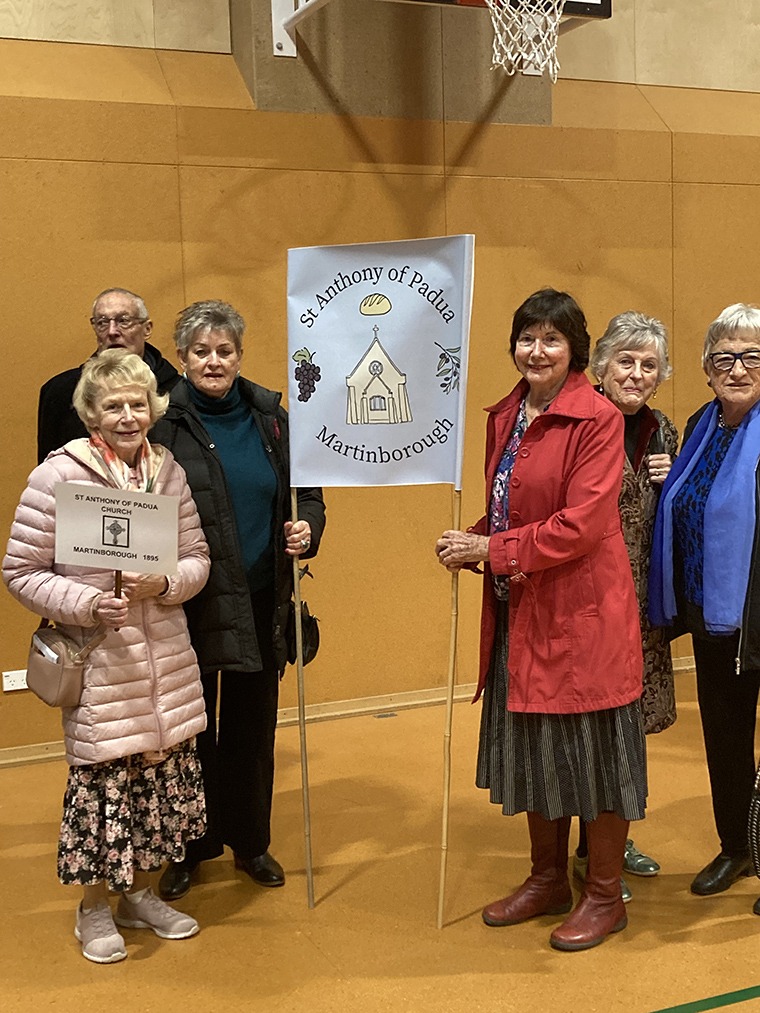
The Celebration started with a Mass at 10am. The Presider and Chief Celebrant was Archbishop Paul Martin assisted by Cardinal John Dew and 5 other priests including our present Parish Priest, Father Dennis Nacorda. Attending was Fr David Moore who grew up in Martinborough. All parishes (past and present) were represented and processed in order of their founding date. St Mary’s, Carterton, built in 1878 came first, followed by Masterton, then Greytown in 1879.Featherston in 1881. Martinborough’s, St Anthony of Padua wooden Church was built in 1895. The 8th Church built in the Wairarapa. It was burnt down on October 10th, 1918. The present Church was opened in late 1923. Churches were also opened in Tinui, Nga Tapu O Te Ariki, (1890) St Brigid’s, Pahiatua,1894 and Eketahuna, 1898. In these early times the Provincial boundaries in NZ had not been formed. Processing next were the Religious educators. The Brigidine Sisters, Marist Brothers, Home of Compassion Sisters who were based in Carterton from 1958 ,then came colleges and schools ( eight in number) plus the organisations like St Vincent de Paul and the Catholic Women’s League. It was a great turnout by the laity. Over 350 attended.
In his homily Archbishop Paul spoke about how we give thanks to God for all that has been done in the past 150 years, is being done now and we look forward to the future in faith and hope.
At the conclusion of the Mass, a book by Dr Claire Hills, titled “HERITAGE AND HORIZON” was launched by Archbishop Paul. This book covers 180 years of Wairarapa Catholic History and the pioneers involved. Chapter 14 ( Defenders of Heritage) is all about Martinborough and our local Catholic Church’s recent history. The writer of this article was surprised to learn that the earliest European Catholics in the Wairarapa were 3 aristocratic English cousins, Charles Clifford, Frederick Weld, and William Vavasour. The 11th Baron William Petre, Chairman of the New Zealand Company, son, Lord Henry was also involved in the Wharekaka Sheep station near Martinborough with Charles Clifford, Frederick Weld and William Vavasour. They leased this land from the local Māori. They drove 600 sheep around the Coast from Wellington.
Charles Clifford became the First Speaker of the House of Representatives in 1854. Frederick Weld New Zealand’s 6th Prime Minister in 1865 and Lord Henry Petre was Colonel Treasurer of NZ and a member of the NZ Legislative Council from 1853- 1860.
Following the ceremony there was a shared finger food lunch before we were entertained by an enactment of Father Halbwachs time in Carterton to his transfer to Reefton. Then the Chanel College Kapa Haka troupe performed for us. This was very well received.
It was a very successful and well attended occasion and a tribute to the organisers. The more Senior of us can now look forward to continuing the legacy and “hopefully” enjoy future celebrations organised by others.