FROM FIELD TO FACTORY
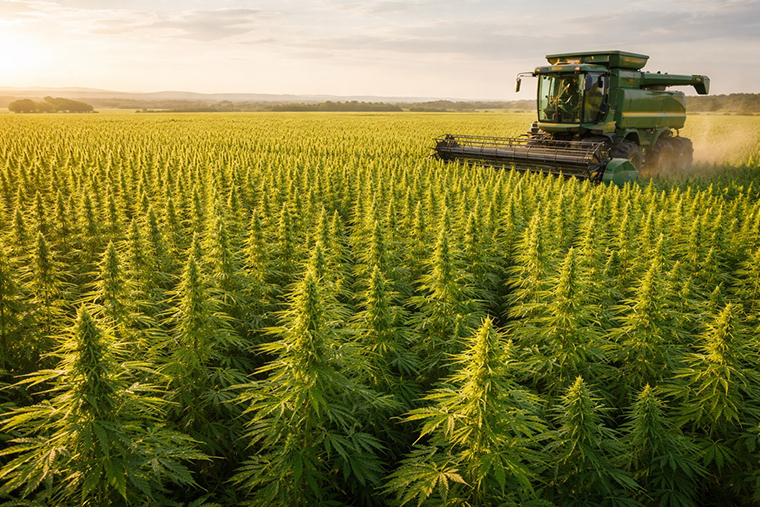
The journey begins in the fields, where hemp grows rapidly without the need for disruptive tilling practices that can damage soil health, and without pesticides.
The first thing the crop does is bio-remediates the soil it is grown in. This mycelium process can be rediscovered down the track for astounding construction techniques and more.
Once harvested, the hemp undergoes sophisticated processing. The raw material is cleaned, washed, milled, and refined to extract its valuable cellulose content. This extraction uses techniques including microwave technology and steam separation.
The fibre and extracted cellulose is processed into an impressive array of products: powders, pellets, pastes, resins, and other ingredients as the foundation for various construction applications. The cellulose can be transformed into rebar, a much stronger and rust-free alternative to steel reinforcement.
REVOLUTIONARY CONSTRUCTION APPLICATIONS
The real magic happens when these hemp-derived materials meet cutting-edge construction technology. With Callaghan Innovation funding, Kerikeri’s Geobind are advancing hempcrete – a building material combining hemp fibre with magnesium-based binders can create a smooth, porridge-like substance ideal for construction. This material could be spray-applied onto super-strong geodesic frameworks, with exceptional insulation properties.
The real magic happens when these hemp-derived materials meet cutting-edge construction technology.
The integration of 3D printing technology accelerates the building process dramatically. Geodesic frames can be printed in three dimensions, providing the skeletal structure onto which hempcrete is applied. In one striking demonstration, entire conventional house walls were created in just 20 hours. Now fully consented, Geobind technology shows the potential for rapid, affordable housing construction and can be taken much further.
ACADEMIC VALIDATION AND ADVANCED APPLICATIONS
The University of Canterbury recognized hemp’s potential with a research partnership in 2023 with innovator start-up TransFibr to explore hemp cellulose. Academic validation fits with hemp-based innovation and opens doors to even more sophisticated applications. Each hemp processing community is its own marketing, scientific and academic faculty with a living curriculum
One particularly innovative direction combines hempcrete with mycelium structures, merging two carbon-sequestering natural materials into hybrid building systems. This biomimetic approach represents the frontier of sustainable architecture, where buildings become living systems that actively improve environmental conditions.
CARBON-NEGATIVE ADVANTAGE
What sets hempcrete apart from conventional building materials is its environmental benefit.
Hemp continues to sequester carbon even after construction, making buildings carbon-negative rather than carbon-positive.
The lime and magnesium-based binders used in hempcrete formulations avoid the high carbon footprint associated with cement. Combining carbon-sequestering hemp fibre and low-impact binders combats climate change with every structure erected.
ECONOMIC CONSIDERATIONS
The cost of a plant to process 100,000 tonnes of hemp fibre, showing a gross return of $4500 per hectare or $45 million, could be $25 million. With 73,000 hectares of grassland in South Wairarapa, putting aside 10,000 hectares is straightforward, particularly as hemp can be grown and harvested without disruption to the usual farm routine. The dollar return is alongside the best dairy production unit and the grassland used can be much lower quality.
Hempcrete is positioned to move from niche material to mainstream construction solution. The question is no longer whether hemp can build our future, but how quickly we can scale to do it.
Geoff Vause 0277344756